

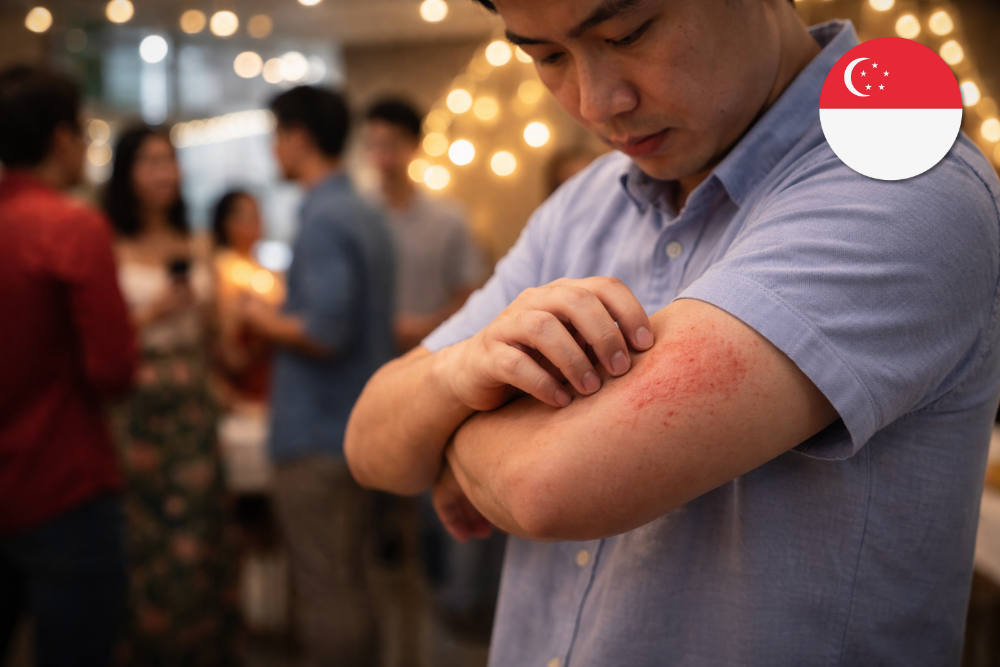
Festive routines often unravel eczema control, and celebrations can quietly become the hardest season for people living with chronic itch.
For many, the festive season is marked by reunions, shared meals and long-awaited gatherings. For Mr Li, however, it often comes with apprehension.


Festive periods tend to disrupt the routines that help him keep eczema and chronic itch under control. What is meant to be a time of celebration can quickly become overwhelming when the skin starts reacting, and what should be a joyful season turns into one that is physically uncomfortable and emotionally draining.
“Festive periods can be challenging because they often disrupt the routines that help keep my eczema under control,” Li shared. “Changes in routine, late nights, rich foods, and different environments can all trigger flare-ups.”
His experience reflects a wider, often unseen reality faced by people living with eczema. Findings from Medical Channel Asia’s ongoing survey, The Unseen Itch, reveal that more than half of respondents living with eczema avoid social events due to flare-ups, with many describing the holiday period as one of the most emotionally difficult times of the year.
One respondent summed it up simply: “When my eczema flares, it affects my mood. I do not feel like meeting people or going out. I feel depressed.”
Survey data reinforces these lived experiences. 34% avoid social events, 31% struggle to go out in public or meet others, and 14% find it difficult to enjoy festive gatherings such as New Year or Christmas.
When Staying Home Feels Like Self-Preservation
For Li, flare-ups have sometimes meant withdrawing from celebrations altogether. He recalls one Christmas Eve when he fell ill and his skin became severely inflamed.
“To avoid drawing attention to my skin or causing others to worry, I chose to stay home,” he said. “It’s not always easy to explain, but sometimes staying home feels like the only way to protect my self-esteem.”
This pattern of withdrawal is echoed across the survey, where 59% of respondents said they have avoided an event or activity entirely because of a flare-up. During festive seasons — when expectations to be present and sociable are high — these barriers can feel even more pronounced.
Another respondent, Ms S, described the emotional toll of feeling different in social settings:
“I often feel unlike everyone else around me — my friends, my co-workers. I am just so tired of living in this body.”
The Social Cost of Chronic Itch
Eczema is often perceived as a surface-level skin condition, but respondents consistently highlighted its deeper emotional and social impact. Poor sleep caused by persistent itch, visible inflammation and the unpredictability of flare-ups create a sense of vulnerability that is amplified during celebrations.
One participant, Mr X, shared: “When the flare-ups appear in visible areas, I tend to avoid attending gatherings.”
Dermatologists note that festive periods can worsen symptoms due to a combination of factors — including warm weather¹, stress², prolonged activity³ and certain festive foods⁴. Chronic itch can affect daily functioning, work, school and social interactions, leading many patients to hesitate or withdraw from gatherings when symptoms are active.
Despite this, many respondents expressed a desire not to isolate themselves, but to be better understood. Yet 95% reported that people around them do not fully understand what living with eczema is like, highlighting a significant empathy gap during the season that most emphasises togetherness.
Beyond physical discomfort, Li emphasised that one of the hardest aspects of living with eczema during celebrations is how easily the condition is misunderstood.
“I wish people understood that eczema and chronic itch are not just minor inconveniences,” he said. “They can be painful, exhausting and unpredictable.”
He added that flare-ups can be triggered by many factors during festive periods, and visible symptoms often affect a person’s confidence. Well-intentioned comments can sometimes deepen discomfort rather than help.
“I hope people can put themselves in others’ shoes and avoid commenting on the condition,” He shared, noting that unsolicited advice or attempts to ‘play doctor’ during social gatherings can feel overwhelming at a time when patients are already physically and emotionally drained.
Sharing Lived Experiences to Strengthen Public Understanding
The survey remains open, and we welcome more individuals living with eczema, as well as caregivers, to share their experiences. These perspectives will help shape upcoming patient stories and public education materials aimed at improving awareness of chronic itch and its daily impact. By sharing your experience, you can help to build a more complete picture of the social, emotional, and daily impact of chronic itch.
Take the survey here.
If you are experiencing ongoing eczema symptoms or uncontrolled itch, consider speaking to your dermatologist or skin specialist. There are now newer, targeted treatment options that may offer more consistent itch relief and support a better quality of life.
For more information about eczema, itch management and treatment pathways, additional resources are available on the Dermatology Chapter (Atopic Dermatitis) Page on Medical Channel Asia.
References
- Hui-Beckman, J. W., Goleva, E., Leung, D. Y. M., & Kim, B. E. (2023). The impact of temperature on the skin barrier and atopic dermatitis. Annals of allergy, asthma & immunology : official publication of the American College of Allergy, Asthma, & Immunology, 131(6), 713–719. https://doi.org/10.1016/j.anai.2023.08.007
- Khalil, N. B., Coscarella, G., Dhabhar, F. S., & Yosipovitch, G. (2024). A Narrative Review on Stress and Itch: What We Know and What We Would Like to Know. Journal of clinical medicine, 13(22), 6854. https://doi.org/10.3390/jcm13226854
- Biazus Soares, G., Hashimoto, T., & Yosipovitch, G. (2024). Atopic Dermatitis Itch: Scratching for an Explanation. The Journal of investigative dermatology, 144(5), 978–988. https://doi.org/10.1016/j.jid.2023.10.048
- Papapostolou, N., Xepapadaki, P., Gregoriou, S., & Makris, M. (2022). Atopic Dermatitis and Food Allergy: A Complex Interplay What We Know and What We Would Like to Learn. Journal of clinical medicine, 11(14), 4232. https://doi.org/10.3390/jcm11144232

