

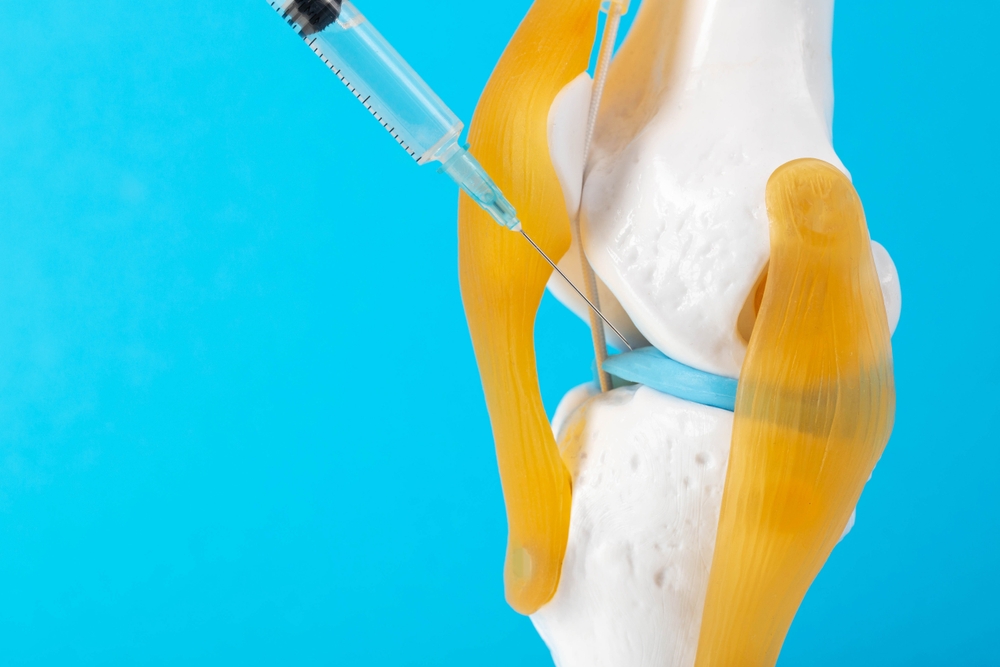
Blocking an ageing-related enzyme helped restore cartilage in damaged and ageing joints, raising hopes for new osteoarthritis treatments beyond surgery.
Cartilage has long been joints’ weak link. Once it wears down, whether through ageing, injury, or osteoarthritis, it hardly grows back. For millions of people across the world, this gradual loss eventually leads to chronic knee pain, stiffness, and eventually, joint replacement surgery.


Now, researchers at Stanford Medicine report that blocking a protein linked to ageing can restore cartilage in damaged and ageing joints of older mice.
What is exciting is that the repair does not rely on stem cells. Instead, it works by reprogramming existing cartilage cells to behave more like their younger counterparts. The findings could point towards a future where cartilage lost to ageing or arthritis may be repaired with an injection or oral medication rather than replaced surgically.
Why is Osteoarthritis So Hard To Treat?
Osteoarthritis (OA) is increasingly common across Asia. Studies suggest prevalence rates range from around 20% to over 60% in different populations, with rates highest among older adults. Knee osteoarthritis is particularly widespread and is a major contributor to chronic pain and mobility loss in the region.
Cartilage is not all the same. Elastic cartilage is soft and bendable, helping structures like the ear keep their shape. Fibrocartilage is thicker and stronger, acting as a shock absorber in places such as the spine. Hyaline cartilage, which coats the ends of bones in many joints, creates a smooth, low-friction surface that allows painless movement. It is this joint cartilage that is most often worn away in osteoarthritis.
Targeting the Root Cause of Osteoarthritis
Rather than easing symptoms, the treatment works by addressing the underlying driver of osteoarthritis.
The therapy centres on a protein called 15-PGDH, which increases in tissues as the body ages. The researchers classify it as a “gerozyme”, a group of enzymes that actively drive age-related tissue decline. In mice studies, the rise in levels of 15-PGDH are a key factor in the loss of muscle strength in older animals, while blocking the protein restored muscle strength and endurance.
As this protein has also been linked to the regeneration of bone, nerve, and blood cells, this led researchers to ask whether the same mechanism might underlie cartilage loss in ageing joints.
When the team examined knee joints, they found that 15-PGDH levels were about twice as high in old mice compared to young ones. The cartilage in older joints was thinner, weaker, and less functional – a pattern that closely mirrors osteoarthritis in humans.
After injecting a small-molecule drug that blocks 15-PGDH, something unexpected was observed.
Cartilage across the joint surface thickened. It was not scar-like or inferior tissue, but smooth, hyaline cartilage – the same type that cushions healthy joints. This happened in aged animals, where cartilage regeneration is normally thought to be impossible.
No Stem Cells Involved
In many tissues, repair depends on stem cells becoming activated and forming new cells. Cartilage behaves differently. Under usual circumstances, hyaline cartilage rarely regenerates.
Instead, existing cartilage cells, known as chondrocytes, altered their gene expression patterns. Harmful genes linked to inflammation and tissue breakdown were switched off, while genes involved in healthy cartilage formation were reactivated.
“This is a new way of regenerating adult tissue, and it has significant clinical promise for treating arthritis due to aging or injury,” said Helen Blau.
“Cartilage regeneration to such an extent in aged mice took us by surprise,” Nidhi Bhutani said. “The effect was remarkable.”
Blau directs the Baxter Laboratory for Stem Cell Biology and is the Donald E. and Delia B. Baxter Foundation Professor, and Bhutani, associate professor of orthopaedic surgery, are the senior authors of the research, which was publihed in Science.
Protecting Joints After Sports Injuries
The approach also showed promise in injury-related arthritis.
ACL tears and similar knee injuries are common in sports involving sudden pivoting or jumping. Even after surgical repair, around half of affected individuals develop osteoarthritis within 10 to 15 years.
In the study, mice treated with the 15-PGDH blocker after knee injury were far less likely to develop osteoarthritis. They also moved more normally and placed more weight on the injured limb compared to untreated animals.
This suggests the treatment may not only repair ageing cartilage, but also prevent long-term joint degeneration after injury.
To test this, the team tested human knee cartilage collected during joint replacement surgeries of patients with osteoarthritis.
After one week of treatment, the tissue showed reduced signs of cartilage breakdown and began forming new articular cartilage. The same pattern of gene “resetting” seen in mice was also observed.
While laboratory tissue in vitro studies cannot fully replicate living joints, the results strengthen the case for moving towards clinical trials.
Phase 1 clinical trials of a 15-PGDH inhibitor in a pill-form, currently targeting age-related muscle weakness, have shown the compound to be safe and active in healthy volunteers. Researchers now hope to extend this work into cartilage regeneration.
“Our hope is that a similar trial will be launched soon to test its effect in cartilage regeneration. We are very excited about this potential breakthrough.” Blau added.
Helen Blau directs the Baxter Laboratory for Stem Cell Biology and is the Donald E. and Delia B. Baxter Foundation Professor, and is one of the senior authors of the research.
References
- Inhibition of 15-hydroxy prostaglandin dehydrogenase promotes cartilage regeneration by Mamta Singla, Yu Xin Wang, Elena Monti, Yudhishtar Bedi, Pranay Agarwal, Shiqi Su, Sara Ancel, Maiko Hermsmeier, Nitya Devisetti, Akshay Pandey, Mohsen Afshar Bakooshli, Adelaida R. Palla, Stuart Goodman, Helen M Blau and Nidhi Bhutani, 27 November 2025, Science. DOI: 10.1126/science.adx6649
- Zamri N A A, Harith S, Yusoff N A M, Hassan N M, Qian Ong Y. Prevalence, Risk Factors and Primary Prevention of Osteoarthritis in Asia: A Scoping Review. Elderly Health Journal 2019; 5 (1) :19-31 http://ehj.ssu.ac.ir/article-1-132-en.html

