


A diabetic foot ulcer may need more than dressings and better blood sugar control. Singapore vascular surgeon Dr Andrew Choong explains how poor circulation can stall healing, why pain is an unreliable warning and when blood flow needs checking.
A small sore on the foot of someone with diabetes is easy to dismiss. It often does not hurt, because diabetes dulls the nerves, so it is covered with a plaster and expected to close. When it does not, the usual explanations are sugar control, footwear or infection. All three matter. But the question that most often decides between healing and amputation is a different one: is enough blood reaching the foot?


Why Singapore Declared War on Diabetes
In 2016 the Ministry of Health declared a War on Diabetes. The reasons were stark. More than 450,000 Singaporeans were living with the condition, one in three of them undiagnosed, and the number was projected to approach one million by 2050 if nothing changed. One in three Singaporeans is at risk of diabetes in their lifetime, a figure the Ministry repeated on World Diabetes Day 2023.
The cost is measured in complications. According to the Ministry, two in three people with new kidney failure had diabetes, as did one in two who had a heart attack. The most visible figure is the foot: nine in ten people who had a lower limb amputation in Singapore had diabetes, and in 2015 the country recorded about 180 diabetes-related major amputations per 100,000 adults with diabetes, three times the OECD average of 60.
The strategy rests on prevention, earlier detection and better disease management. The foot wound is where vascular surgery earns its place.
Why a Wound Will Not Close
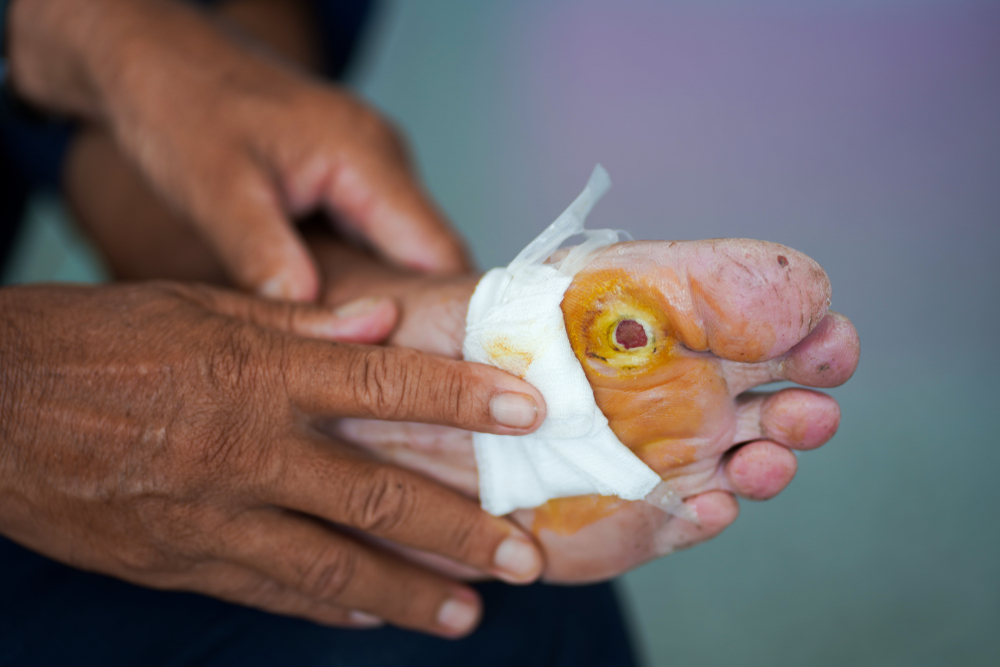
Healing is work, and work needs supply. Oxygen, nutrients, immune cells and antibiotics all reach a wound through the bloodstream. Diabetes narrows the arteries of the leg, often silently and often low down near the foot. The result is a wound that has everything it needs except a blood supply.
The Eurodiale study, which followed 1,229 patients with a new diabetic foot ulcer across ten European countries, found peripheral arterial disease in 49 per cent. The 2023 international guideline on arterial disease in the diabetic foot puts the figure at approximately half.
Yet the classic warning sign, calf pain on walking, is often absent in diabetes because nerve damage hides it.
Why Circulation Changes the Outcome
Eurodiale showed why this matters. A year after presentation, 84 per cent of ulcers in patients with good circulation had healed, against 69 per cent in those with arterial disease, whose rates of major amputation and death were three to four times higher. The authors concluded that the two should be treated as different conditions.
An ulcer is rarely a one-off. A review in the New England Journal of Medicine estimates that up to a third of people with diabetes will develop a foot ulcer, and that once healed, around 40 per cent return within a year and two-thirds within five.
Screening: The Circulation Check Nobody Should Skip
The international guideline recommends that every person with diabetes and a foot wound be assessed for arterial disease, symptoms or not, and that people with diabetes and no wound have their circulation checked every year, so that disease is found before it causes a non-healing ulcer.
Feeling for Pulses
Feeling for the two foot pulses is a reasonable first step, but the guideline is candid that it has limited diagnostic value and cannot rule arterial disease out.
Measuring the Pressures
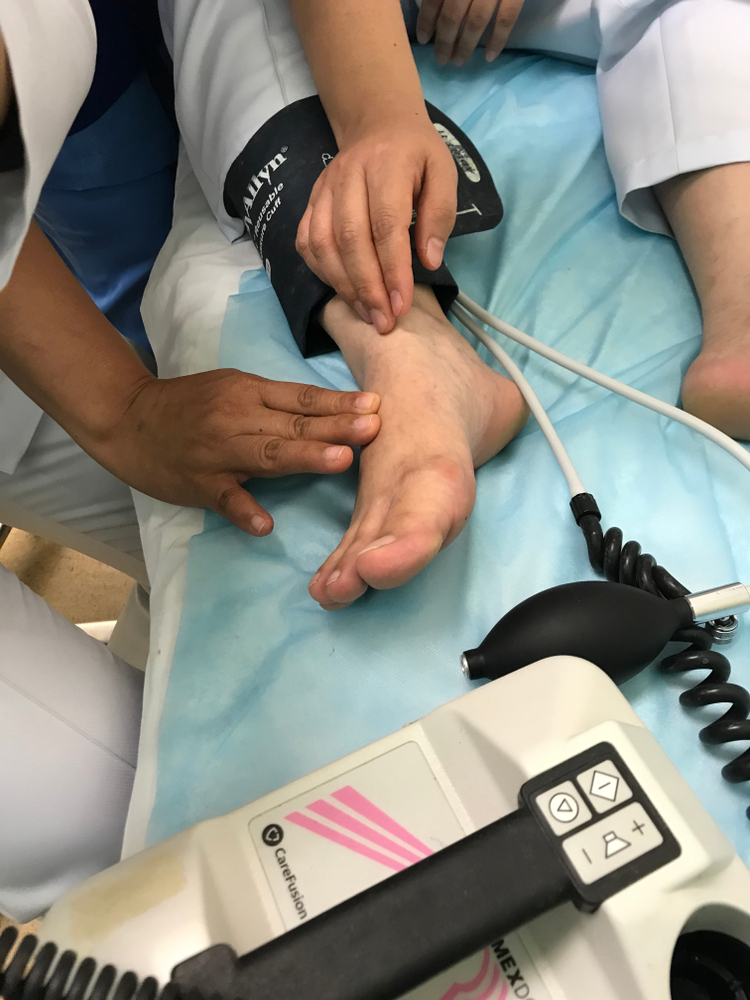
The reliable tests use a hand-held Doppler probe and a blood pressure cuff. The ankle-brachial index compares the pressure at the ankle with the pressure in the arm. The toe-brachial index does the same with a tiny cuff on the big toe, which matters because calcified ankle arteries in diabetes can give a falsely reassuring reading. The guideline considers arterial disease less likely when the ankle-brachial index sits between 0.9 and 1.3, the toe-brachial index is 0.70 or above, and the Doppler waveforms are brisk. A toe pressure of 30 mmHg or more also favours healing; below that, the risk of major amputation rises.
Seeing the Arteries
Where the pressures are abnormal, the arteries are mapped. The guideline recommends colour duplex ultrasound as the first imaging test: a scan without radiation or injection that shows where the narrowing is and how much flow gets past. In a dedicated vascular ultrasound laboratory the pressures and the scan are done at the same visit, so the patient leaves with an answer rather than a referral.
The Four-Week Rule
The guideline offers a benchmark patients and families can use. If a wound has not shrunk by at least half within four weeks of good standard care, the blood supply should be reassessed and a vascular specialist consulted about restoring it.
Gangrene, spreading infection or a very low toe pressure should not wait four weeks: they need an urgent vascular opinion, because the timing of drainage and revascularisation decides what can be saved.
Restoring the Supply: The Minimally Invasive Way Forward
A narrowed or blocked artery can usually be reopened from the inside. Through a needle puncture under local anaesthetic, a fine wire is passed across the blockage and the artery opened with a balloon, sometimes drug-coated, and occasionally a stent. There is no incision to heal, which matters when the problem is that wounds do not heal, and most people go home within a day.
These endovascular techniques have transformed the treatment of peripheral arterial disease in the diabetic foot, where blockages are often long, hard and low in the leg, and open surgery once meant a large operation in a frail patient. Bypass still has a place when the anatomy demands it, but for most patients a minimally invasive approach comes first. The aim is not the procedure but what it enables: a wound with the supply to close, and a limb that stays.
Warning Signs to Act On
Be seen promptly, not at the next routine visit, for: a break in the skin not clearly healing within two weeks; a wound pale, dusky or black at the edges; a foot colder or paler than the other; foot pain at night eased by hanging the leg down; and redness, swelling or discharge. Numbness is not reassurance. It is the reason the wound went unnoticed.
Questions to Ask Your Doctor
- Has my circulation been measured, not just felt?
- What were my ankle and toe pressures?
- Has the wound shrunk by half since it was first measured?
- If not, who is looking at the blood supply?
Sugar control, footwear and clean dressings are necessary, but not always sufficient. If Singapore is to win its war on diabetes at the level of the foot, circulation belongs in the conversation from the first visit, not the last.
Dr Andrew Choong is a vascular, endovascular and aortic surgeon in Singapore at Andrew Choong Vascular Surgery (drandrewchoong.com).
References
- Ministry of Health Singapore. War on Diabetes: Summary Report 2016-2019. https://isomer-user-content.by.gov.sg/3/de338897-bda1-4673-a555-8cbe906c0952/wod_public_report.pdf
- Ministry of Health Singapore. Singapore’s War on Diabetes (background brief). https://www.ourcommons.ca/Content/Committee/421/HESA/Brief/BR10093093/br-external/MinistryOfHealth-Singapore-e.pdf
- Ministry of Health Singapore. Speech at World Diabetes Day 2023. https://www.moh.gov.sg/newsroom/speech-by-madam-rahayu-mahzam-senior-parliamentary-secretary-ministry-of-health-ministry-of-law-at-world-diabetes-day-2023-5-november-2023-230pm-at-wisma-geylang-serai/
- Prompers L, et al. High prevalence of ischaemia, infection and serious comorbidity in patients with diabetic foot disease in Europe. Baseline results from the Eurodiale study. Diabetologia 2007;50:18-25. https://link.springer.com/article/10.1007/s00125-006-0491-1
- Prompers L, et al. Prediction of outcome in individuals with diabetic foot ulcers: focus on the differences between individuals with and without peripheral arterial disease. The EURODIALE Study. Diabetologia 2008;51:747-755. https://link.springer.com/article/10.1007/s00125-008-0940-0
- Fitridge R, et al. The intersocietal IWGDF, ESVS, SVS guidelines on peripheral artery disease in people with diabetes mellitus and a foot ulcer. 2023. https://iwgdfguidelines.org/wp-content/uploads/2023/07/IWGDF-2023-05-PAD-Guideline.pdf
- Armstrong DG, Boulton AJM, Bus SA. Diabetic foot ulcers and their recurrence. New England Journal of Medicine 2017;376:2367-2375. https://www.nejm.org/doi/full/10.1056/NEJMra1615439

