


Facing a surge in Parkinson’s Disease Singapore cases, Alexandra Hospital is complementing sterile consultations with a Parkinson’s Cafe to provide holistic, social care.
Stepping away from the sterile, fluorescent-lit hallways of a standard hospital, patients find a more inviting atmosphere in a sun-lit corner of Alexandra Hospital. Here, the traditional 15-minute medical review has been reimagined as a warm, social gathering. Over coffee and home-baked cookies, the clinical team and patients sit together, allowing the white coat barrier to vanish.


Launched as a pilot in April 2025, the Parkinson’s Cafe, a Clinic-Cafe hybrid, is a radical departure from traditional care. The programme was born after Dr. Preetha Venugopalan Menon, a Consultant in Geriatric Medicine, and her team went on a fellowship overseas to learn more about integrated, community-based care models.
While observing patient-led support groups, the team noticed a missing link: the absence of healthcare professionals to address immediate clinical needs on the spot. This reimagined model has blossomed into a two-hour session held every alternate month where clinical reviews are woven into a social fabric, ensuring that patients do not just receive a prescription, but a community.
The Growing Challenge of Parkinson’s Disease in Singapore
Parkinson’s Disease is one of the top four neurological conditions in Singapore. Currently, it affects approximately 3 in every 1,000 Singaporeans aged 50 and above. The urgency for better care models is clear: at Alexandra Hospital alone, the number of Parkinson’s Disease patients increased from 84 to 256 from 2022 to 2025.
This local spike mirrors a global trend where the number of people living with Parkinson’s Disease has doubled over the last 25 years. As Singapore approaches 2030—where one in four citizens will be aged 65 or older—the healthcare system is bracing for a significant increase in cases.
The condition is known for its physical symptoms, such as:
- Tremors (shaking)
- Rigidity (muscle stiffness)
- Impaired balance
- Sleep disturbances
However, the invisible symptoms like mood changes, care-giver burnout, and social isolation are often just as important. These issues frequently go unaddressed in a standard, fast-paced clinic visit.
Why the Cafe Setting Beats the Formal Clinic
In a traditional 15-minute consultation, a patient often performs for the doctor. They sit up straight and answer questions directly, sometimes subconsciously hiding their daily struggles. Medical professionals often refer to this as “masking.”
When the white coat comes off and the coffee is poured, the clinical team sees the reality of daily life. In the cafe, the team can observe a patient navigating a crowded room or reaching for a cup—moments where freezing of gait or cognitive fatigue become visible in ways they never would in a sterile exam room.
“In the clinic, we have a computer between us; I’m typing while listening,” says Dr. Preetha. “In the cafe, I sit on the couch with them. We can address side effects or adjust medications on the spot, so they do not have to wait four months for their next appointment.”
By integrating a clinical review into a social setting, the hospital has created a one-stop environment. This model allows for:
- Timely Intervention: Healthcare professionals can adjust medications or therapy on the spot if they notice symptom progression or side effects.
- Better Symptom Management: Patients are more likely to discuss daily struggles in a relaxed environment.
- Preventative Monitoring: Proactive monitoring helps catch complications before they require emergency care.
The Power of Shared Learning and Care-giver Support
One of the most significant benefits is the peer-to-peer exchange. Patients share life hacks that no textbook provides, such as using chia seeds for constipation or a specific finger-pressing technique to steady tremors.
For many, the greatest symptom is the shrinking of their world. Mdm Wong, a 75-year-old former auditor diagnosed with Parkinson’s Disease in 2019, found her world narrowing as her handwriting deteriorated to the point that banks rejected her cursive English signature, leading her to adjust her signature to a Chinese signature.
Unlike many her age, she avoids attending Active Ageing Centres, admitting that she is not very social, and instead finds a sense of purpose and mutual understanding at the Parkinson’s Cafe. “Coming here gives me a chance to interact with people outside my small circle,” she says.

Now, she bakes granola and chocolate chip cookies to share with the group, finding dignity in a community that understands her specific journey. These connections often extend beyond the two-hour sessions; the team has observed patients forming “ping-pong pairs” and even arranging to travel home together.
A Multidisciplinary Team Under One Roof
Effective Parkinson’s Disease care is never a solo mission; it requires a specialised, synchronised unit. The cafe is powered by Dr. Preetha’s dedicated multidisciplinary team, which includes a specialised Parkinson’s Disease nurse, a pharmacist, a case manager, physiotherapists, and other allied healthcare members.
Before each session, the team conducts a huddle to streamline which patients need specific attention, whether it is a medication adjustment or a mobility check. During the first hour, the team circulates among patients to check their blood pressure and conduct head-to-toe medical reviews. The second hour is social and educational, featuring interactive talks on everything from swallowing difficulties to tremor management.
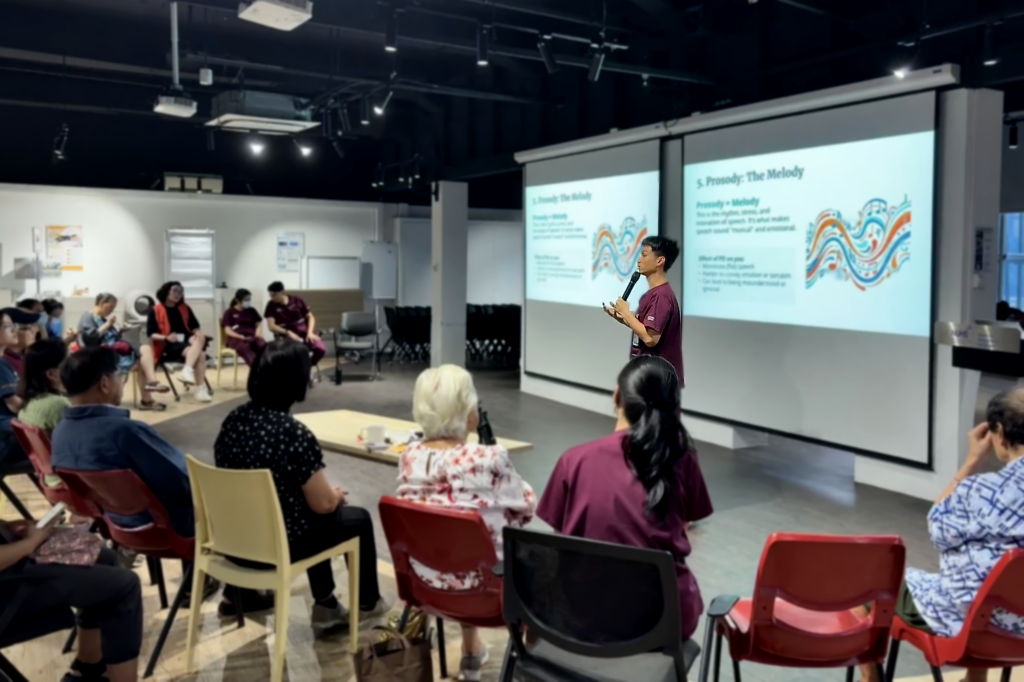
During the sessions, pharmacists like Ms Golda Wang can offer personalised, relaxed consultations that go beyond pill counts. “When it’s informal, they are more willing to share,” Ms Golda explains. “We learn about new therapies and adaptive devices together, like weighted spoons or cups that help reduce tremors. We can use the information from the education session, like practising mindfulness, to help them cope better.”
Building a Sustainable Future for Chronic Care
As Alexandra Hospital prepares to redevelop into an integrated health campus by 2028, the Parkinson’s Cafe serves as a blueprint. Although the Parkinson’s Cafe is currently only available for patients in the early stages of Parkinson’s Disease, the team is currently considering how this Clinic-Cafe model could be adapted for the later stages of Parkinson’s Disease, or other conditions such as dementia or sarcopenia.
By reviewing multiple patients in a group setting while maintaining personalised attention, the hospital improves efficiency while deepening the quality of care. The impact, however, is measured in more than just efficiency. For Dr. Preetha, the shift in setting has changed her own relationship with her work. She recalls the heartwarming experience of watching a once-resistant patient find inspiration in others.
“When they hear from someone else that the medication is working, or they share a tip that helps another, the atmosphere changes,” she says. “It is so warm and uplifting—I feel a serotonin rush for the entire day.”
For the residents of Singapore living with Parkinson’s Disease, the message is clear: you do not have to face this journey alone. Sometimes, the best medicine starts with a conversation over a cup of coffee.
References:
- Dorsey, E. R., & Bloem, B. R. (2018). The Parkinson Pandemic—A Call to Action. JAMA Neurology, 75(1), 9-10. https://doi.org/10.1001/jamaneurol.2017.3299
- Ministry of Health Singapore. (2023). Action Plan for Successful Ageing. https://www.healthhub.sg/programmes/115/action-plan-for-successful-ageing
- National Neuroscience Institute. (n.d.). Living with Parkinson’s Disease. https://www.nni.com.sg/patient-care/conditions/parkinsons-disease
- Parkinson’s Foundation. (n.d.). Caring for yourself. https://www.parkinson.org/resources-support/carepartners/caring-for-self
- Parkinson Society Singapore. (n.d.). Understanding Parkinson’s. https://www.parkinson.org.sg/
- Radder, D. L. M., de Vries, N. M., Terhorst, C., et al. (2020). Multidisciplinary Care for People with Parkinson’s Disease: The New Standard? Journal of Parkinson’s Disease, 10(s1), S89–S95. https://doi.org/10.3233/JPD-202135
- World Health Organization. (2022, June 14). Parkinson disease. https://www.who.int/news-room/fact-sheets/detail/parkinson-disease

