

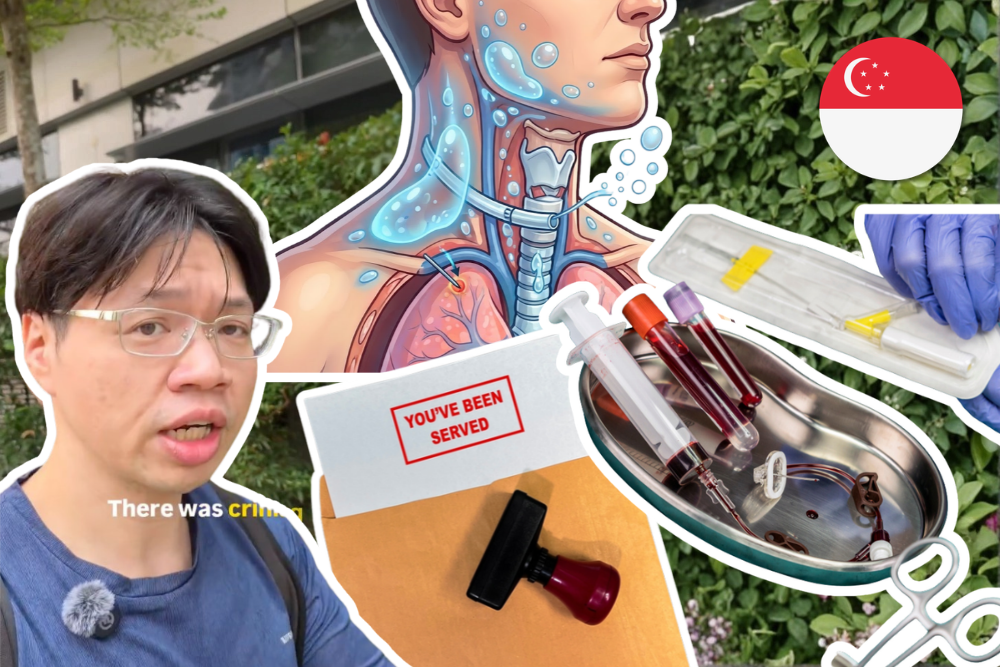
We expect doctors to never flinch, but what happens when human hands make a terrible mistake? Following Dr Pipetius Quah’s viral confession, we examine the heavy silence surrounding clinical complications, and what really heals the bond between doctor and patient when things go sideways.
Imagine pressing your fingers against a patient’s neck and feeling it crackle like bubble wrap.


That was the exact moment Dr Pipetius Quah, a lung specialist in Singapore, knew something had gone terribly wrong. His patient had just survived a massive heart attack, but his blood pressure was dangerously low. To deliver life-saving medication, Dr Quah needed to insert a central line into a large vein in the patient’s neck.
View this post on Instagram
What Happened Next?
Putting in a central line is not like getting a routine IV drip in your arm. It is an invasive, high-risk procedure where a doctor has to guide a large needle deep into the neck or upper chest, working just millimeters away from major pulsating arteries and the very top dome of the lung. In an emergency setting, where a patient’s pressure is crashing and seconds count, the room for error is razor-thin.
It’s also why what happened next isn’t actually an anomaly. Medical literature shows that an accidental lung puncture is one of the most recognized mechanical risks of central line insertions, happening in roughly 1-3% of cases. On a consent form, a 1-3% risk looks like a tiny gamble for a chance to save a life. But when you are the doctor holding the syringe, those odds mean that if you do this enough times, you may eventually hit the lung.
In Dr Quah’s case, the line went in smoothly. But as he pressed down on the patient’s neck to suture it in place, his fingers felt something terrifying: the skin crackled like bubble wrap.
In medicine, that crunch has a name: subcutaneous emphysema. The needle had inadvertently grazed the lung, puncturing it. It can cause air to collect directly in the pleural space (causing a pneumothorax) or track upward along fascial planes and through the puncture site into the soft tissues under the skin (causing subcutaneous emphysema).
To prevent the lung from completely collapsing, the team had to immediately slice into the patient’s chest to insert a drainage tube. Because the air leak was stubborn, an already critically ill man had to stay tethered to that painful chest tube for weeks.
The Second Victim Syndrome
We like to think of doctors as infallible experts who never flinch. But behind the scrubs, they are just regular people working under intense pressure. When a procedure goes sideways, the guilt can be suffocating.
For weeks afterward, Dr Quah’s hands shook every time he had to insert a neck line. He second-guessed every move, wondering if he was losing his edge.
This is a recognized phenomenon called the “Second Victim” syndrome. First coined by Dr Albert Wu in 2000, it describes the shame, anxiety, and trauma healthcare workers experience when they inadvertently cause harm.
When an error happens, the patient suffers first as the first victim. However, the healthcare worker often carries a quiet, crippling shame – the “second victim”. Doctors and nurses are trained in a culture that demands absolute perfection. When a human mistake inevitably happens, the institutional response is rarely to offer psychological support. Instead, clinicians are often left completely isolated, drowning in guilt, shame, and the fear of losing their license.
Second Victim Syndrome is real – The tragic case of Kim Hyatt
by
u/Ghostwriter881 in
nursing
Yet, medical training rarely teaches doctors how to process that fear. Instead, the unspoken rule is simple: swallow it, put on a brave face, and move to the next bed.
The Problem With the Culture of Silence
In a healthcare settings especially, admitting fault is treated like career suicide. The pressure to save face, protect the hospital from lawsuits, and maintain an aura of authority means complications are often swept under the rug or masked behind heavy medical jargon.
When things go wrong, the standard playbook is usually defensive. Doctors are coached to be cautious, say as little as possible, and let hospital administrators handle the fallout.
The problem is that this defensiveness makes patients feel gaslit. Most people understand that surgery and critical care come with real risks. What actually makes patients frustrated or angry is not always the mistake alone – it is the cold, evasive attitude that follows. When a doctor hides behind technical terms and refuses to own what happened, it’s not difficult to see how trust can fall apart.
The Apology
Once the patient was stable, Dr Quah walked into his hospital room, fully prepared to be cursed out. He looked the man in the eye and confessed: I did this to you.
The patient didn’t scream. Instead, he gave the doctor a rare gift: forgiveness. “Doctor, you did what you had to do,” the patient told him.
“These things happen, and I know that you didn’t mean it.”
That grace gave Dr Quah closure, prompting him to share a rule taught by his seniors: reflect, don’t ruminate. Don’t drown in paralysing self-blame; learn from the complication so you can give the next patient the best version of yourself.
Furthermore, studies on medical malpractice show that Dr Quah’s patient’s reaction is not an anomaly. When hospitals adopt an “Open Disclosure” policy – such as University of Michigan Health System’s Disclosure, Apology, and Offer (DA&O) model, where doctors are taught to immediately apologise and explain errors, the lawsuit rates actually decrease. mWhat usually drives patients to hire lawyers is not the mistake itself, rather it is the feeling of being lied to or abandoned by a system that refuses to own its faults.
What Would You Do As The Patient?
It is easy to read a story like this and appreciate the happy ending, but maybe it raised some uncomfortable questions about how we view doctors and how we react when things go wrong.
At the end of the day, doctors are not machines. They get exhausted, anatomy can be tricky, and high-risk procedures carry real odds of failure, even in the best hands. But knowing that logically is very different from experiencing it yourself.
Think about it:
- If you woke up from a procedure in pain, and the doctor walks in and say, “I punctured your lung,” what would your immediate reaction be? Would you be furious, or would you appreciate the honesty?
- Does hearing a doctor admit their mistakes publicly make you lose faith in the medical system? Or does it actually make you trust them more?
- If you have ever had a medical procedure go sideways, how did your healthcare team handle it? Would you have preferred it to go any other way?

