


Johnson once emceed weddings and traded improvised lines in rap battles. After a stroke at 45, even a WhatsApp message became difficult. Rebuilding his life would take far more than finding his words again.
Johnson used to be the person who could pick up a microphone and keep a crowd entertained without much preparation.


“Communication was one of my greatest strengths,” he says. “I used to emcee events, including weddings, and could comfortably entertain crowds without much preparation.”
Away from the microphone, there was football, snooker and video games. There were trips, movies, music and time with friends. He had built a career across insurance, payments and compliance, and was accustomed to supporting himself.

“I was independent, confident and accustomed to doing things quickly.”
Then, at 45, a stroke interrupted the life he knew.
The man who once entertained a room would find himself struggling to compose a message on his phone. Returning to work would bring an almost daily desire to quit. Even explaining how distressed he felt would become difficult.
His recovery would involve learning how to do familiar things again, while coming to terms with how unfamiliar he sometimes felt to himself.
The Night His Body Stopped Responding
On 3 October 2025, Johnson met friends who were playing badminton and returned home around midnight.
Shortly afterwards, he collapsed after coming out of the toilet.
He managed to pull himself upright near the kitchen sink. His wife arrived and tried to help him sit down, but he could not maintain his balance.
“What frightened me most was that I could still hear and see everything around me, but I had lost control of my body,” he recalls.
“At that point, I knew something was terribly wrong, but I had absolutely no idea I was having a stroke.”
When Singapore Civil Defence Force paramedics arrived, Johnson remembers that they initially suspected a heart attack. One reassessed his condition and recognised the stroke. He was taken directly to Singapore General Hospital, where he received urgent medical attention within roughly an hour.
“I genuinely believe that the paramedics’ swift judgment and the hospital’s rapid response made an enormous difference to my outcome.”
He subsequently spent approximately two days receiving treatment and monitoring in a high-dependency setting, including management of his blood pressure.
The experience almost felt like a dream.
Getting Help Starts With Recognising The Signs
Stroke is the fourth leading cause of death in Singapore. Yet knowing what is happening, and calling for help, can still be the first hurdle.
A regional report commissioned by Siemens Healthineers, drawing on insights from seven stroke experts across six Southeast Asian countries, identified delays before patients reach specialist care as a major barrier to timely treatment. These included low public awareness of symptoms and difficulties transferring patients between hospitals.
Singapore has made substantial progress in reducing stroke death rates. Yet a regional expert report identified a remaining weakness closer to home: people may still fail to recognise the symptoms and call for help quickly enough.
That delay is something Johnson now cautions against. At 45 and relatively active, he had no prior warning symptoms that he personally recognized before collapsing.
“Do everything reasonably within your control to reduce your risk of having a stroke,” he emphasizes.
“Take your health seriously, attend regular health screenings and follow medical advice. Don’t assume being relatively young or active makes you immune.”
Part of that preparation means knowing when an emergency is unfolding and acting without hesitation.
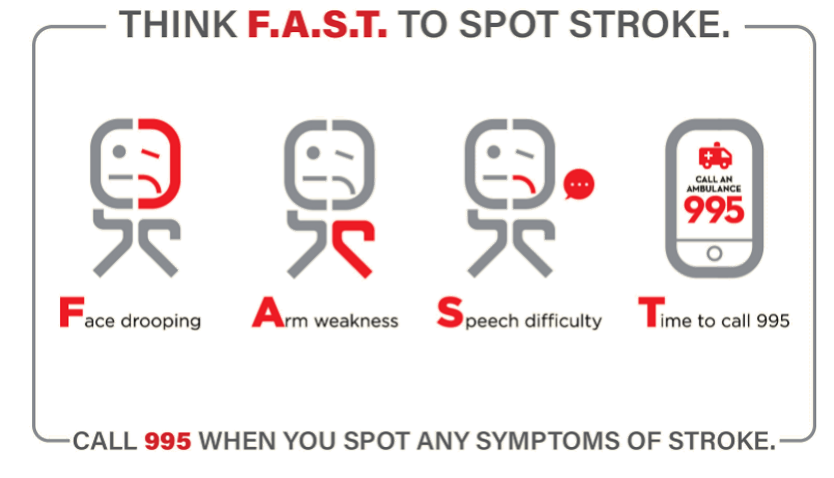
Knowing the warning signs matters: Face drooping, Arm weakness, Speech difficulty, Time to call 995. Any one of these signs warrants an immediate emergency call, even if the symptoms improve.
When The Wrong Words Came Out
As Johnson began recovering, the biggest changes he noticed were cognitive rather than physical.
He developed aphasia, a condition that affects language. Depending on the person, it can disrupt speaking, understanding, reading and writing.
For Johnson, memories remained largely intact. Accessing the words to express them was another matter.
“Sometimes I knew exactly what I wanted to say, but completely different words would come out,” he says. “I also had to relearn aspects of reading, spelling, writing and working with numbers. Even composing a WhatsApp message became challenging.”
The contrast with his earlier life was painful. Before the stroke, he could easily emcee events, improvise jokes and be spontaneous in his conversations. Afterwards, even forming simple sentences became difficult.
That experience is shared by other survivors. Fellow stroke survivor Terence Ang described a similar separation between what he could think and what he could say.
“It felt as if there was an invisible wall between my mind and my mouth,” Terence said.
For Johnson, speech therapy and practice gradually helped him rebuild his communication. He can now write emails, communicate professionally and hold conversations reasonably well.
It remains a work in progress – he still needs time to organise his thoughts, and continues to notice differences in his processing speed, word retrieval and multitasking. He also unexpectedly developed stage fright, despite his years of experience addressing large audiences.
Finding Support While Finding His Words
People wanted to be there for Johnson after his stroke. His wife had helped him during the emergency, medical professionals were guiding his recovery, and friends wanted to visit and check on him.
Yet being surrounded by people who cared did not always make it easy to explain what he was going through.
For months, Johnson felt he had lost an important part of himself. He experienced depression unlike anything he had known before, while aphasia made it harder to put that distress into words.
“What made it worse was my aphasia. Imagine knowing exactly how distressed you feel but being unable to explain it. That can be incredibly isolating.”
Even with familiar people, there was a gap between what he felt and what he could share. Even people who genuinely care cannot always understand what a stroke survivor is experiencing internally.
Johnson appreciated people checking on him, but the attention sometimes became overwhelming. What helped was having room to recover without needing to explain everything he was feeling.
Around two months after the stroke, he travelled to Australia and spent three weeks with close friends.
“That experience became an important part of my recovery as my friends gave me the space to recover at my own pace.”
Alongside his wife’s support and ongoing medical care, that time with friends offered something he needed: companionship with space to take things slowly.

Humour and music also helped him cope. For someone who had once entertained crowds and improvised jokes, laughter became a small but meaningful part of finding himself again.
“Watching comedy shows helped me laugh again.”
Through these different forms of support, Johnson came to appreciate that helping someone recover does not always mean stepping in or knowing exactly what to say.
“Sometimes, patience, understanding and space are equally valuable.”
Back At Work, Wanting To Leave
Finding employment after the stroke was difficult.
Johnson attended around five or six interviews before securing his current role. He encountered difficulties during some interviews after disclosing his medical history. Eventually, a close friend helped him obtain the interview opportunity that led to a banking compliance position.
He returned to work on 2 June 2026.
Getting the job was a significant step. Managing it while still recovering was another challenge.
“During the early months, I wanted to quit almost every day,” he says. “The work was demanding, and I was still dealing with the cognitive effects of my stroke. However, I needed to earn a living after months of unemployment had substantially depleted my savings.”
Work drew on experience he had accumulated over years in financial services. But he was doing it while still managing changes in how he processed information and communicated.
Several colleagues encouraged him through those early months, and this helped things to improve over time.
“Gradually, I developed more efficient ways of handling cases, and my confidence returned. Eventually, colleagues began approaching me for advice.”
Within approximately four months, he had made more progress than he initially thought possible.
Being asked for advice was a meaningful change from wanting to quit almost every day. His experience and judgement still had value, even as he continued finding ways to manage the work.
“That showed me I could still succeed professionally after a stroke.”
He previously held more senior responsibilities. For now, returning to employment has been an important part of rebuilding his career, confidence and financial independence.
The Cost Of Surviving
The financial consequences have stayed with Johnson – having spent around six months out of work while covering living expenses and medical costs – even with insurance, the burden was enormous.
“I want people to understand that the cost of surviving a stroke extends beyond hospitalisation,” he says. “There are ongoing consultations, medications, rehabilitation and the consequences of being unable to work.”
For him, recovery includes rebuilding savings that were depleted while he was unable to earn. Financial independence, once an established part of his life, has become something he is working towards again.
“My biggest priority today is rebuilding my financial stability and independence.”
Alongside work, he continues managing his health. Medical investigations uncovered a basilar artery aneurysm. Managing his condition has meant navigating procedures that became unexpectedly daunting after the stroke: while MRI scans had never bothered him in the past, an earlier examination post-stroke left him so overwhelmed that he had to press the emergency button to be pulled out.
During a follow-up scan on 14 October 2026, he was determined to see it through. Pushing through the initial discomfort, he found a sense of calm and completed the full examination – a quiet personal milestone that proved he could still overcome hurdles he had begun to fear were beyond him.
Daily life also involves managing blood pressure and using a CPAP machine for sleep apnoea.
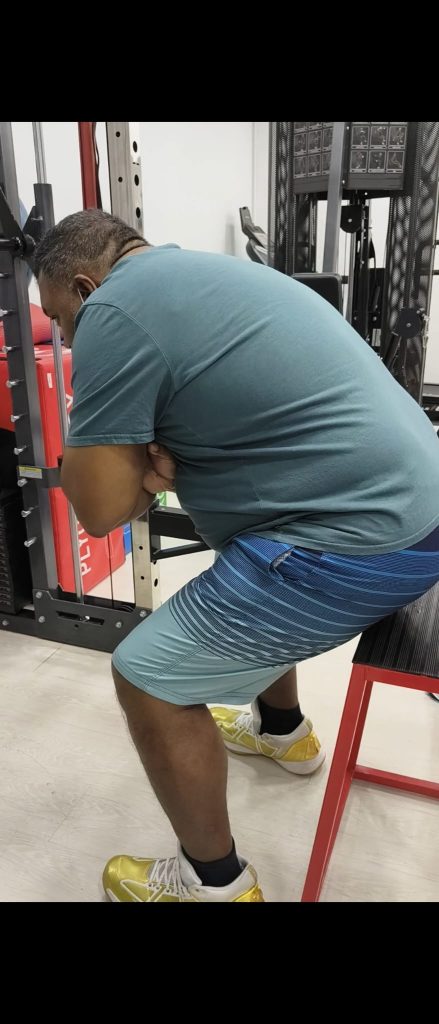
He has adjusted his medication routine, weight management and physical activity, and continues working on memory, word recognition and numerical processing. These efforts have become part of everyday life, alongside the job and the bills.
There Are Still Things He Wants To Do
Johnson has plans beyond recovery.
He wants to obtain his driving licence. He wants to improve his cognitive abilities and rebuild his savings. He would also like to explore starting a business with his wife, whose baking specialities include gluten-free and low-carb creations.
These plans sit alongside the work of recovery. There are medical appointments, daily blood pressure checks and continued practice with words, memory and numbers. There is also a career to rebuild, and the satisfaction of discovering that colleagues value his advice.
He wants people to see that experience and ability, even when he needs more time to express himself.
“I don’t want to be defined by my stroke. I want to be recognised for the work I can do.”
Johnson has felt the difference that patience can make. Friends gave him space to recover at his own pace. Colleagues encouraged him through the months when he wanted to quit. Gradually, he found himself doing more than he had thought possible.
“You can still work, laugh, travel and pursue your ambitions. You may simply have to find a different way forward.”
The man who once entertained wedding crowds still has things to say and plans he wants to pursue. Finding his words again is part of making those plans possible.
“Surviving a stroke and recovering from one are two very different things.”
“I’m still working on the second part, and I have absolutely no intention of giving up.”
Photos courtesy of Johnson

