

Singapore has transformed haemophilia into a manageable condition – but patients are now asking a deeper question: what does it mean to truly live beyond it?
For decades, haemophilia was a condition defined by fear: of uncontrolled bleeding, of disability, of shortened life expectancy. Today, in Singapore, that narrative has changed.


With improved access to treatment, structured care pathways, and enhanced support through MediShield Life and MediSave, haemophilia is no longer the life-threatening diagnosis it once was. Many patients now live longer, healthier lives, supported by preventive treatment regimens and specialist care.
But beneath this progress lies a complex reality.
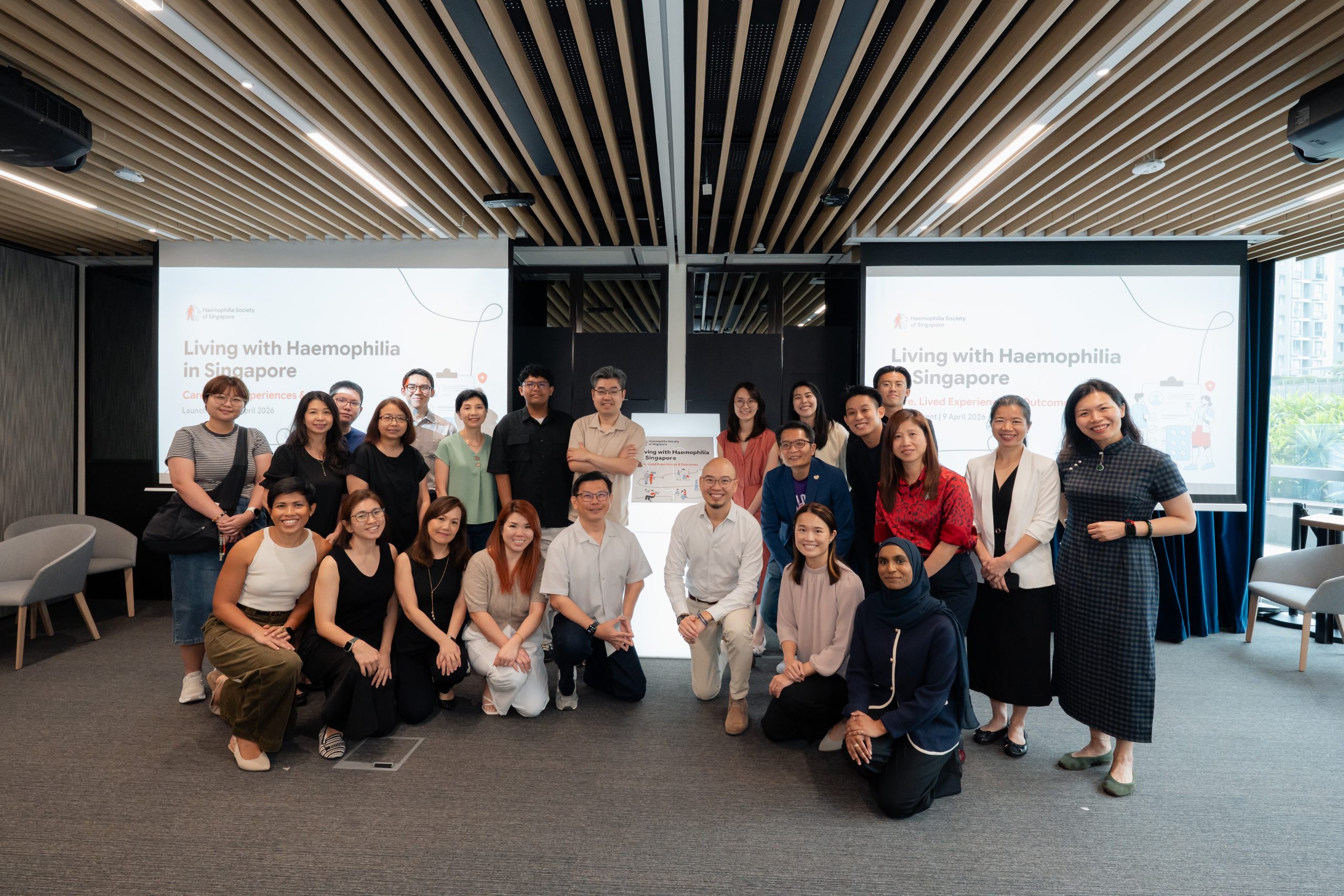
A recent national study carried out by Haemophilia Society of Singapore (HSS), Living with Haemophilia in Singapore: Care, Lived Experiences and Outcomes, reveals that patients are grateful for how far care has come, yet many still do not feel free from the condition.
What is Haemophilia?
Haemophilia is a rare, lifelong condition where the blood does not clot properly. While it is often hereditary, about 30% of patients do not have a family history of the condition.
This happens because the body lacks certain clotting proteins (clotting factors) which are essential for stopping bleeding. As a result, people with haemophilia may bleed longer than usual after injuries, or experience spontaneous internal bleeding, particularly into joints and muscles.
There are two main types of haemophilia:
- Haemophilia A, which is caused by a deficiency in clotting factor VIII and is the more common form
- Haemophilia B, which is caused by a deficiency in clotting factor IX
The severity of the condition depends on how much clotting factor a person has. In more severe cases, bleeding can occur without any obvious injury, and repeated bleeds over time can lead to chronic joint damage and reduced mobility.
In Singapore, haemophilia remains a rare condition, affecting approximately 280 individuals. The majority live with haemophilia A, while a smaller proportion have haemophilia B. Nearly half of patients have severe disease, requiring regular preventive treatment to reduce the risk of bleeding and long-term complications.
While advances in treatment have significantly improved outcomes, haemophilia remains a condition that requires ongoing, lifelong management.
If Treatment Works, Why Does Life Still Feel Limited?
On paper, haemophilia care in Singapore is a success story.
80% of patients adhere to preventive treatment plans, and close to 90% believe their treatment is effective in managing their condition.
Yet these promising figures do not always translate to well-being. Even maintaining that level of adherence is not as straightforward as it appears.
Treatment itself carries a burden. Regular intravenous infusions can be physically uncomfortable, time-consuming, and mentally taxing. Some patients report anxiety, fear of needles, or even phobia related to injections. Up to 50% of patients struggle with the act of self-administering medication — a process that requires precision, confidence, and routine repetition.
Furthermore, despite regular treatment, 85% of patients reported experiencing bleeding episodes in the past year, with nearly half requiring hospital care. On average, patients experience six breakthrough bleeds annually, even while on consistent factor prophylaxis.
This reflects a real limitation of current therapies, in both clinical outcomes and daily experience of people living with haemophilia (PwH).
Living With Constant Calculation
Beyond treatment related considerations, daily life for people with haemophilia often involves an invisible layer of calculation:
- Can I join this activity?
- Is my protection level high enough today?
- What happens if I fall, or strain a joint?
These are ongoing mental processes that shape everyday decisions. Physical activities, travel plans, and even career choices are often filtered through the lens of safety.
Over time, this creates what researchers describe as a “resilience burden” – the unseen effort required to maintain stability in the face of a lifelong condition.
From Survival to Something More
In the past, the goal was survival – preventing life-threatening bleeds and maintaining basic function. Today, expectations have evolved.
Patients are no longer asking, “Can I live?”
They are asking, “Can I live normally?” They aspire a “haemophilia-free mind”, a state where the condition no longer dictates daily decisions, routines, or future plans.
Many patients recognise the significant progress that has been made, especially when compared to earlier generations who faced more severe limitations, but nearly one in three patients expressed a desire to switch treatments. It reflects a growing awareness that better treatment options exist that are less invasive, longer-lasting, or easier to integrate into daily life, and a wish for these options to be more accessible.
The findings point to a broader shift in how haemophilia care needs to be understood.
Medical management alone is not enough – what is needed is a more holistic model of care. Care should address all aspects, from physical health, to psychological well-being, social participation, and long-term independence.
A Different Kind of Freedom
World Haemophilia Day has long been about awareness. But in Singapore today, awareness is no longer the main issue. The foundation has been built, patients are living longer, healthier lives than ever before, and the system has evolved to support them.
The next phase of haemophilia care is not just about preventing bleeds – it is about protecting what comes after.
That means safeguarding long-term mobility, before repeated bleeds erode independence over time. It means reducing the treatment burden itself, so that care does not become a daily source of friction – physical, logistical, or emotional.
It also means addressing something less visible: the mental load of living with haemophilia. The constant calculation, the quiet anxiety, the need to plan life around risk. Moving towards a “haemophilia-free mind” is not about eliminating the condition, but about reclaiming independence and active living in spite of it.
And perhaps most importantly, it means recognising that haemophilia is never carried alone.
Behind every patient is a network of caregivers navigating their own set of trade-offs – in time, finances, and emotional energy. Easing this shared burden, through clearer guidance, stronger psychosocial support, and better financial navigation, is just as critical as any medical advancement.
Taken together, these shifts point to a more holistic vision of care — one that looks beyond treatment, and towards participation.
“Ultimately, our goal is for PwH to spend less time managing the logistics of their condition, and more time living fully — contributing their talent, energy, and potential to the broader tapestry of Singaporean society.” shared Gerald Foo, president of HSS.
For a deeper look into the findings, read the full report by HSS here.

