


Cats have an impressive hold over humans. We happily clean their litter trays, rearrange our furniture for them and accept that the most expensive cat bed will inevitably be ignored in favour of a cardboard box. But what if our fondness for cats is not entirely our own?
That provocative theory centres on Toxoplasma gondii, a common parasite capable of altering the behaviour of infected rodents. Some researchers have questioned whether it could also influence human behaviour, including how we respond to cats.


The evidence, however, is much more complicated than the headlines suggest.
What Is Toxoplasmosis?
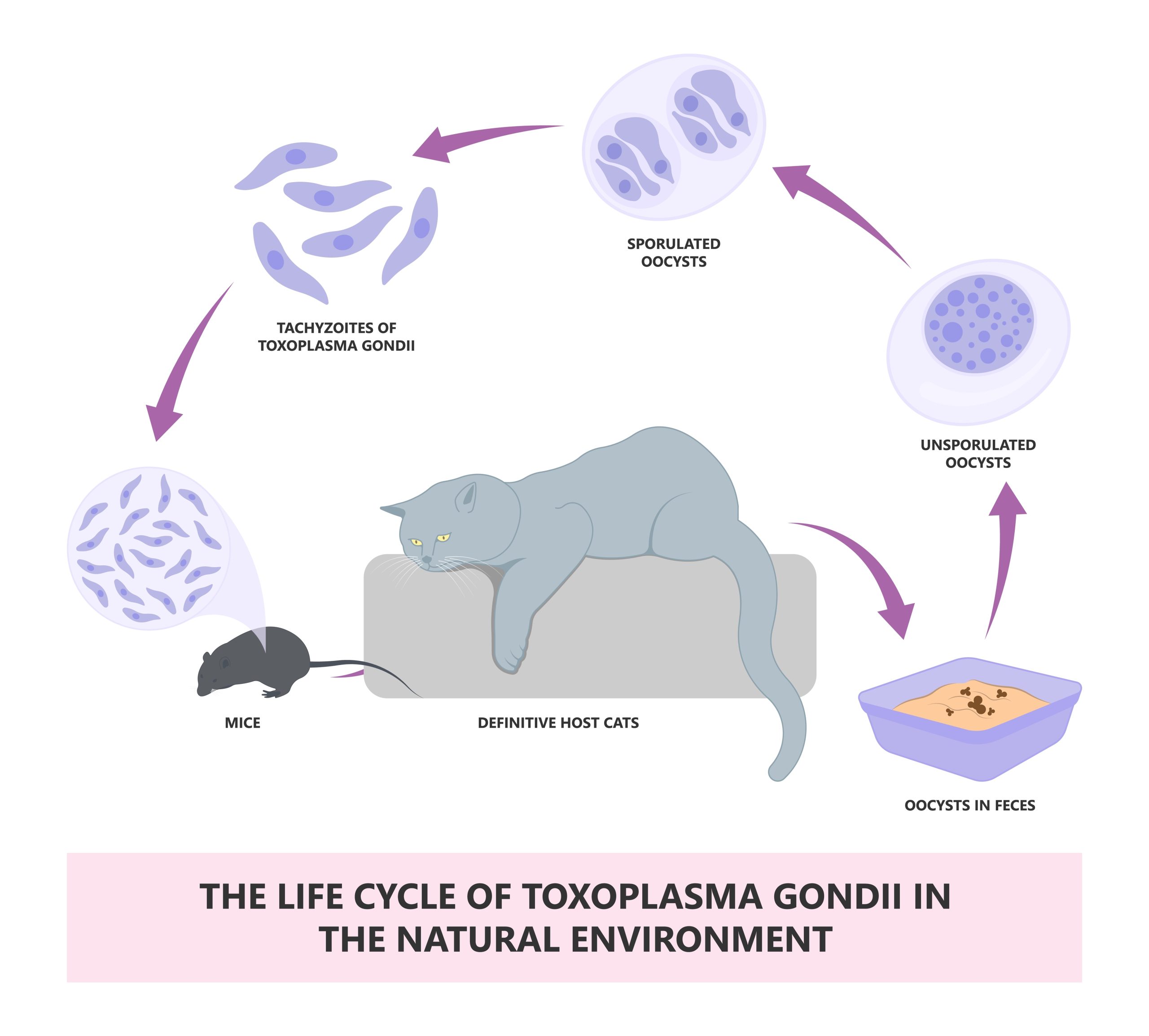
Toxoplasmosis is an infection caused by the microscopic parasite Toxoplasma gondii.
The parasite can infect humans and almost all warm-blooded animals. However, cats are its “definitive host”, meaning members of the cat family are the only animals in which it can complete the sexual stage of its life cycle.
After becoming infected, a cat may shed parasite eggs, known as oocysts, through its faeces. These can enter the environment and contaminate soil, water, fruit and vegetables.
Humans can become infected by:
- Eating raw or undercooked infected meat
- Consuming contaminated fruit, vegetables or water
- Handling contaminated soil or cat litter and then touching the mouth
- Passing the infection from mother to baby during pregnancy
- Receiving an infected organ transplant or blood transfusion, although this is rare
Contrary to what many people assume, simply stroking a cat is unlikely to give you toxoplasmosis. Contaminated food and soil are also important sources of infection.
How Toxoplasmosis Turns Fear Into Attraction
The theory that toxoplasmosis could influence our love of cats began with a strange discovery in rodents.
Rats and mice naturally avoid the smell of cats. It is a survival instinct: where there is a cat, there is a strong possibility of becoming dinner.
Yet researchers found that rodents infected with T. gondii appeared to lose some of this natural fear. In several experiments, infected rodents spent more time exploring areas containing cat odours instead of avoiding them.
This phenomenon has been described as “fatal attraction”.
The behavioural change may help the parasite complete its life cycle. If an infected rodent becomes less cautious around cats, it may be more likely to be caught and eaten. The parasite then returns to the feline host it needs to reproduce.
It is a remarkably effective strategy, if the parasite is truly responsible for the behavioural change.
However, more recent research suggests the effect may not be as specific as once believed. Rather than deliberately making rodents attracted to cats, the infection may produce broader changes in fear, anxiety or risk-taking.
Does Toxoplasmosis Affect Human Behaviour Too?
This is where the science becomes far less certain.
Some studies have found associations between latent toxoplasmosis and differences in reaction time, risk-taking, personality or cognitive performance. One small study even suggested that infected and uninfected individuals may rate the smell of cat urine differently.
However, these findings do not prove that toxoplasmosis makes people love cats or that the parasite is deliberately controlling human behaviour.
Most of the research in humans is observational. This means researchers can identify patterns, but they cannot confirm what caused them.
For example, someone who spends more time around cats may have a greater chance of encountering contaminated litter or soil. In that case, their love of cats may have increased their likelihood of infection, rather than the infection creating their love of cats.
Human behaviour is also influenced by countless biological, psychological, social and cultural factors. A person’s affection for cats cannot be reduced to the presence of a single parasite.
Would You Know If You Had Toxoplasmosis?
Most healthy people with toxoplasmosis never realise they are infected.
The immune system usually keeps the parasite under control, and many people experience no symptoms at all. When symptoms do appear, they may resemble a mild case of influenza.
Possible symptoms include:
- Fever
- Headache
- Muscle aches
- Tiredness
- Swollen lymph nodes
After the initial infection, T. gondii can remain inactive within the body for many years. It usually does not cause further illness in people with healthy immune systems.
However, the parasite can cause serious complications in people with severely weakened immune systems, including those living with advanced HIV or receiving certain cancer treatments or immunosuppressive medications.
In these individuals, toxoplasmosis may affect the brain, eyes or other organs. Symptoms such as confusion, seizures, poor coordination or changes in vision require urgent medical attention.

Why Is Toxoplasmosis a Concern During Pregnancy?
Toxoplasmosis is particularly important during pregnancy.
If a woman becomes infected for the first time during or shortly before pregnancy, the parasite may cross the placenta and infect the unborn baby. This is known as congenital toxoplasmosis.
Some infected babies may not have obvious symptoms at birth but develop health problems later. Possible complications include vision loss, hearing problems, seizures and developmental difficulties.
The risk of passing the infection to the baby generally increases later in pregnancy. However, infections that occur earlier may cause more severe complications.
Pregnant women do not usually need to give away their cats. Instead, the US Centers for Disease Control and Prevention recommends taking additional precautions around food, soil and cat litter.
Can Cat Owners Prevent Toxoplasmosis?
A few practical habits can help reduce your risk of infection.
Handle Cat Litter Carefully
Ask someone else to clean the litter tray if you are pregnant or immunocompromised.
If this is not possible, wear disposable gloves and wash your hands thoroughly afterwards. The litter should be changed daily because the parasite generally takes between one and five days after being shed to become infectious.
Keep Cats Indoors
Keeping cats indoors reduces their chances of hunting and eating infected animals.
Cats should be fed commercial cat food or thoroughly cooked food rather than raw or undercooked meat.
Cook Meat Thoroughly
Undercooked meat is an important source of toxoplasmosis. Cook whole cuts and minced meat to a safe internal temperature, and avoid tasting meat before it is fully cooked.
Wash knives, cutting boards and kitchen surfaces after they come into contact with raw meat.
Wash Fresh Produce
Rinse fruit and vegetables thoroughly under running water before eating, peeling or preparing them.
Wear Gloves While Gardening
Soil may be contaminated even when there are no cats visibly present. Wear gloves while gardening or handling sand, and wash your hands afterwards.
Should You Get Tested for Toxoplasmosis?
Routine testing is not usually needed for healthy people without symptoms.
A doctor may recommend a blood test if toxoplasmosis is suspected, particularly during pregnancy or in someone with a weakened immune system. Additional tests may be required if there are concerns about infection affecting the eyes, brain or unborn baby.
Treatment depends on the individual’s symptoms, health status and stage of pregnancy. Healthy people with mild symptoms often recover without medication, while higher-risk cases may require antiparasitic medicines.
Speak to a healthcare professional if you are pregnant and believe you may have been exposed, or if you develop concerning symptoms after handling raw meat, soil or cat litter.
References
- Centers for Disease Control and Prevention. (2025). Toxoplasmosis: Biology, transmission, clinical presentation and diagnosis. https://www.cdc.gov/dpdx/toxoplasmosis/index.html
- Centers for Disease Control and Prevention. (2024). Preventing toxoplasmosis. https://www.cdc.gov/toxoplasmosis/prevention/index.html
- Berdoy, M., Webster, J. P., & Macdonald, D. W. (2000). Fatal attraction in rats infected with Toxoplasma gondii. Proceedings of the Royal Society B: Biological Sciences, 267(1452), 1591–1594. https://doi.org/10.1098/rspb.2000.1182
- de Haan, L., Sutterland, A. L., Schotborgh, J. V., Schirmbeck, F., & de Haan, L. (2021). Association of Toxoplasma gondii seropositivity with cognitive function in healthy people: A systematic review and meta-analysis. JAMA Psychiatry, 78(10), 1103–1112. https://doi.org/10.1001/jamapsychiatry.2021.1590

